
Digital Marketing 101
The ultimate guide to everything digital marketing for freelancers, marketers, entrepreneurs, SMEs, and enterprises.
The ultimate guide to everything digital marketing for freelancers, marketers, entrepreneurs, SMEs, and enterprises.
Digital marketing, or e-marketing; is the necessity these days. Businesses are relying on them, and the trend will continue to grow as more and more parts of the world turn towards digitalization.
This guide is your ultimate digital marketing resource to read, learn from, refer back to, and share with others.
Whether you are a marketer, a startup owner, or a business manager, read on for complete knowledge about digital marketing, including strategies to create a fool proof digital marketing plan.
In simple terms, as the name suggests, any and every marketing activity conducted using digital platforms is broadly referred to as digital marketing.
Although vastly similar, the terms digital marketing and online marketing are often used interchangeably, and wrongly so. Online marketing can be classified as a sub branch of digital marketing, in more apt terms.
Digital marketing is defined by using numerous digital tactics and channels to connect with customers where they spend much of their time online.
While digital marketing is any type of marketing occurring on digital platforms, any sort of digital marketing happening across the internet is called online marketing. The two terms are often confused, but they share subtle differences. Digital marketing is a broader term and involves all or any strategies that involve digital media and electronic devices. Meanwhile, online marketing is a part of digital marketing and specifically restricts to internet-based marketing.
For example, a beer company running a promotional campaign on their social media channels, digital billboards in malls, and via SMS is using digital marketing for promotional activities. But if they were only using social media channels, like running Facebook ads or using SEO to rank in search engines, they would be using solely online marketing. You can choose either based on your company’s type (B2B or B2C).
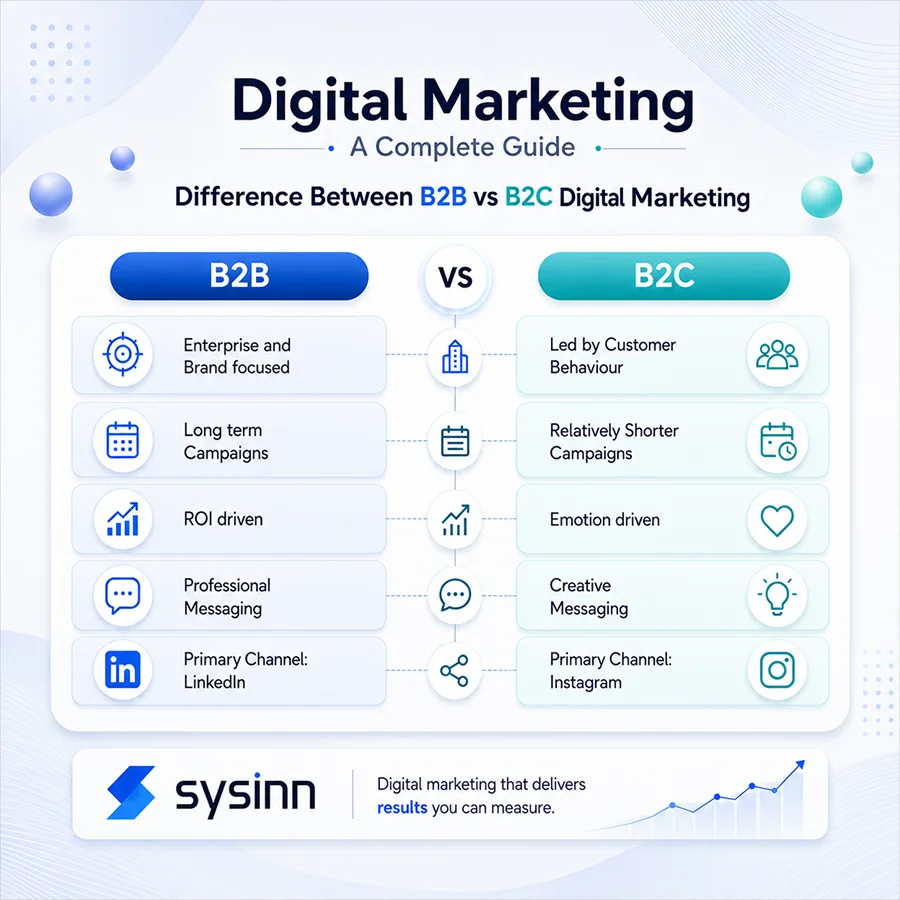
As is evident from the title, the answer is pretty much clear. However, for starters, any digital marketing campaign or strategy aimed at promoting a business or business provider is B2B. B2C, on the other hand, is working directly for consumers, and aiming digital campaigns for the goals and benefit of the general populace.
In order to drive action, companies can use a plethora of online tools, including social media channels, search engines, and online apps specifically designed to facilitate communication to promote and sell products and services.
When compared to traditional marketing, digital marketing does more than just inform customers about the product features; it helps you understand customer needs and actively engage to fulfill those needs. It essentially creates a dialogue that helps customers find solutions. More importantly, it helps you find customers right where they are, so you can easily reach and engage.
Digital marketing uses various strategies, including but not limited to:

Focus on how your brand’s website performs on the search engine. It involves SEO (Search Engine Optimization) and other technicalities to be taken care of.

Targets social platforms to promote products and/or services using online paid and non-paid campaigns to reach potential customers.

Reaches out to users via promotional emails and funnels to build relationships and facilitate conversions. Including cold as well as warm outreach.

Uses highly targeted paid promotions to reach potential customers on the internet. Includes SEA (Search Engine Advertising or paid keyword purchasing).

Helps increase customer base by incentivizing promotions. Affiliates for your brands earn commissions in return for promoting your products.

Helps build an audience where your brand products are promoted both directly and indirectly (via Inbound Marketing).

Targets potential customers on mobile devices via SMS. Usually, it focuses on discounts and promotions.

Involves the optimization of your brand’s social media profile to improve customer engagement.
Regardless of its type, digital marketing relies on messaging that communicates a brand’s or a business’s unique value proposition to the intended audience. The goal is to eradicate any communication gaps between the user and the brand to facilitate action.
When done right, digital marketing can foster relationships with both potential and repeat customers, who rely on social media, search engines, and other apps to acquire information about products and services, the information that plays a critical role in their decision making.
So, digital marketing is, simply put, a way to connect with customers via online channels to build not just a customer base, but a community that, over time, helps you grow.

But what essentially constitutes digital marketing? It is important to first, at a glance, see how it evolved over time to what we practice today.
We cannot fully understand the impact or importance of digital marketing without knowing its roots.
Digital marketing started in the 1990s with the first clickable web ad. After that, websites and emails became one of the most prominent tools for communication and early digital marketing.
Search Engine Optimization gained popularity in the early 2000s with Google. Website optimization became a norm and paid search started to gain ground. Optimizing a website for search engine ranking became important for both small brands and prominent companies.
Social media platforms gained significant prominence with Facebook, Twitter, and YouTube. Companies began to actively engage with customers and build a following to create lasting bonds with both repeat and potential customers.
Mobile marketing became an integral part of digital marketing with SMS marketing, push notifications, and mobile friendly websites that allowed improved user experience. Today, digital marketing relies on automation, analytics, and personalization to enhance user engagement for profitable returns.
As of the year 2026, these are the following main digital marketing channels.
Social media marketing involves platforms like Facebook and Twitter to connect with the target audience and deliver tailored ads to build brand awareness, drive engagement, and increase sales. Through social media, you can run ads and interact directly with customers to build trust.

Digital marketing is everywhere around you. You are constantly exposed to ads, and you may not even notice them. From app notifications to social media ads, brands are constantly reaching out to customers. It has become a part of our daily lives; it is how we find products and services. Below are some real-world examples of how digital marketing is used.
When customers search for a specific product online, such as “buy sneakers online” on Google or other search engines, the very first results shown are the paid ads. You will notice the label “sponsored” with them.
For Example:
IfI you search for the keyword “buy sneakers online”, you will see the sponsored ad for Rule.

Fast Fact
As per DataReportal, in April 2026, a total of 6.12 billion people around the world used the Internet, more than 70% of the world’s population. This represents a huge opportunity for digital marketing; you can reach more than half of the world’s overall population simply through online platforms.
Digital marketing holds many benefits. Here are a few notable ones:

One of the most significant benefits of digital marketing remains a wider reach. With social media platforms and other online tools, you can reach over half of the world’s population without any geographical or language barriers. A single search engine ad, a sponsored social media post, or a review by an influencer can put your brand on the map. You have the chance to create a stronger brand awareness to increase visibility and your potential for more customers. For example, a sneaker brand like Rusle can sell in Norway, all while exposing the brand to millions of Instagram users with sponsored ads.

Compared to traditional marketing, digital promotional efforts offer higher cost savings. With traditional marketing, your ad options are very limited. Meanwhile, with digital marketing, you can have highly targeted ads that reach specific audiences based on age, location, and preferences. For example, you can run a targeted Facebook ad for your brand at an affordable cost and reach your potential customers; your ad only goes out to people who are likely to buy your product.

Since digital marketing allows for targeted advertising, you can get far more measurable results than traditional marketing. With analytical tools, you can track the progress of your ads and learn what works and what doesn’t, which gives you a deeper insight into how to promote your brand and what adjustments to make for enhanced results. For example, with Google Ads, you can track the number of impressions and overall user engagement to track progress.

Digital marketing makes it easier for you to create personalized content based on customer preferences. You can create ads, emails, blogs, and recommendations according to your audience. For example, with user behaviour tracking, you can make product suggestions based on the user's previous search history and therefore increase conversions.

With digital marketing, you have the chance to be a part of the user's buyer journey, from awareness to purchase. For example, you can first create an ad to generate awareness about your product, then offer discounts to drive sales, and later send out notifications to encourage repeat purchases. This is only possible with digital marketing; traditional markets offer a one-way advertising where you can promote, and hope customers will return.

With digital marketing, the time between discovery and purchase is greatly reduced. Customers can go from finding the product to purchasing it within a few minutes. For example, a user can see your product’s ad on Instagram and click the link in the bio to directly go to the online store to complete the transaction.

It is only via digital marketing that you can align business goals with marketing efforts. For example, you can create specific promotional campaigns (campaigns to increase sales or to create brand awareness) with targeted ads and reach specific business goals. That way, you can focus on building several aspects of business for enriching growth.
Learn How Digital Marketing Efforts Drive Business Success in the Modern World.
Read MoreHere’s a breakdown of simple digital marketing concepts:
Search Engine Optimization, in simple words, is a way to make your website appear higher in search engine rankings, like Google, to increase visibility so customers can find your products and services quickly. The better your visibility is on the search engine, the higher the likelihood of selling more products.
SEO ensures your customers find you online easily (on the first page of Google)

Digital marketing does not constitute one core skill; instead, it's a combination and working knowledge of multiple interconnected skills.

Writing and creativity go hand-in-hand in digital marketing. Engaging content, which includes emails, blogs, and ads help you communicate with people so they can become customers or support for your business. Only good writing will encourage your audience to take action, such as signing up for your newsletter or buying your product.

SEO and SEM help you get discovered on the internet on search engines like Google. In order to do SEO and SEM right, you need to have good writing skills. Content like blog posts and website landing pages helps bring free traffic and visibility.

Once you are on the internet with engaging content, you can use social media channels like Instagram, Twitter, and YouTube to promote your content so people can find your website and your products and services.

Simply having content on your website or social media postings is not enough. You have to track the progress of your marketing efforts to understand what works and how to improve results. Analytics tells you:

How many people visited your website
How many watched or clicked your ad
How many watched or clicked your ad
A key performance indicator in digital marketing is metrics that help you analyze your marketing efforts to measure overall performance. They help you measure if your marketing campaigns are producing the desired result, such as engagement, traffic, and sales.
The total number of visitors to your website, their location, age, gender and activity level on each page.
Example:
If 30,000 visitors visit your web page in a month, that is your KPI for traffic.
This measures how many visitors to your website sign up, buy, or engage with the content. Not all visitors engage, so you have to know if your target audience is taking the desired action. If , you need to make adjustments.
Example:
If 100 people visit your site in a month and 5 buy your product, you have a 5% conversion rate.
The Click through rate KPI shows how many people clicked your ad after seeing it.
Example:
If 100 people see your ad and 50 click the link or ad, your CTR IS 5%.
This KPI shows how much you have to pay every time a user clicks on your ad.
Example:
If you get 20 clicks for $ 10, your CPC will be $0.50. CPC = total cost of ads divided by total number of clicks.
The customer acquisition cost KPI measures the total cost of acquiring a new customer.
Example:
If you spend $500 on various digital marketing efforts, such as content marketing, SEO, SEM, and SMS marketing, and attract 10 new customers, your CAC is $50.
The Return On Investment (ROI) measures your overall profit against the overall spending.
Example:
if you spend 200 dollars on all marketing efforts and earn 500, you have a positive ROI; your profit covers all your marketing costs.
The Engagement Rate KPI measures how visitors/users interact with your content via shares, likes, and comments.
Example:
A social media post with 1000 views and 100 likes has a 10% engagement rate. The higher the rate, the more visibility and purchases you can expect.
Google Analytics 4 (GA4) is a free KPI measuring tool that shows, in depth, how users interact with your website or web pages. Unlike the older versions of Google Analytics, this version focuses on the user behaviour across different devices rather than just website pages. This gives you a much in-depth analysis of user behaviour to create better marketing campaigns.
Instead of pages, GA4 tracks video views, clicks, scrolls, and purchases. For example, if your user clicks the 'Buy’ button, GA4 measures it as an event, so you know exactly how many users clicked the ‘Buy’ button.
With GA4, you can track b both mobile and website data all in one place to track users across different platforms. For example, when a user browses a product on mobile and later makes a purchase on desktop, GA4 measures that as a single user purchase journey.
GA4 focuses more on individual user behaviour rather than overall traffic. As a result, you are able to track both new and returning users and understand the key metrics behind their behaviour. For example, how many times a user visits a page before they make the buying decision.
GA4 offers key predictive insights using AI to help you forecast a user’s behaviour. For example, it helps you predict if a user will make a purchase soon or stop using your app. With predictive analysis, you can create ads or offers that help users convert.
One of the most prominent features of GA4 so far is its ability to visualize how users move step-by-step. For example, it tracks how users go from product view to add to cart to checkout and then purchase.
This information helps you see how many users drop off at the checkout (or any other step of the funnel) and create ads and strategies to reduce that drop off.
Apart from the above main features, you can:
Set up anomaly detection alerts
Set up hourly insights for tracking with email alerts
Link Google Analytics 4 with Google Merchant Centre
Enable non-human and anti-spam activity with measurement protocol API secrets
Interlink and connect Google Analytics 4 with Google Merchant Centre
Conversion rate optimization strategy that helps improve your website or app in order to encourage visitors to take a desired action, such as make a purchase, sign up for a newsletter, fill out a form, or download an app.
Conversion rate measures the number of visitors who take the desired action.
Conversion rate = conversion / total visitors * 100
For example, an e-commerce website owner running an online store uses GA4 to track the site’s performance.
Before optimization, the site had 1000 visitors and 20 purchases. Conversion rate 2%^.
With GA4, the site owner tracks performance and finds out that many users add items to the cart but leave at the checkout page. So, he optimizes his site by introducing fewer steps towards the checkout, adding Cash on Delivery option, improving page speed, and showing trust badges to gain users’ trust.
That’s how CRO helps you gain more results from the same visitors, so you don’t have to target new users all the time.
A UX design refers to user experience, the overall experience and feel a user has when interacting with a website, app, or a product or service. A good UX website helps users find products quickly, has a good page load speed and offers a simple checkout and payment system to complete the transaction.
As a digital marketer, you don’t have to become a UX designer; you simply need to understand what role UX design plays in your users’ buyer journey to improve overall engagement and conversions.
Here are a few UX skills you need as a digital marketer:
You need to understand who your users are and what exactly they need.
You can do this via:
User personas
Customer pain points (based on the personas)
User behaviour analysis
For example, by using Google Analytics 4, you can measure and monitor users’ behaviour and create ads and offers accordingly. If a user leaves your site quickly after landing, you can investigate and take action based on what they expected and what they saw.
The next important thing that you need to focus on is content organization, so the visitors can easily find what they need.
It includes:
Clear website menus with categories
Easy-to-follow page structure
Simple navigation
For example, if you have an e-commerce store, it is important to have a logical category structure, such as Men, Men’s shoes, Men’s undergarments.
The easier it is for the customers to find your products, the more conversations you will have.
You need to have a design with usability in mind. The overall design of your website should encourage a certain action, such as signing up or purchasing. If your design doesn't do that, it needs work.
Visual hierarchy guides users and makes navigation easier.
This includes:
Font size and spacing
Color contrast
Overall content layout
Key info highlights
For example, the CTA should always be prominent. A big, bold ‘Buy Now’ always catches the user's attention. And encourages action.
In this day and age, when users discover products on mobile first, it is crucial to make mobile optimization a critical part of your overall UX design. This includes:
Responsive website that easily loads
Touch-friendly buttons
Fast page loads to help with navigation
UX design is an ongoing challenge that every digital marketer must tackle. To make this easy, use analytics and behaviour tracking to monitor user behaviour.
This includes:
Conversion tracking
Heatmaps
User flow analysis
For example, if Google Analytics 4 shows you that users are dropping off at the checkout, you make checkout simpler to improve conversions.
Digital Marketing is used across many different industries, from retail to telecommunication, but some sectors rely on it more heavily, depending on the engagement level with customers.

Retail and consumer goods manufacturers are some of the biggest users of Digital Marketing. This sector relies heavily on digital marketing channels like SEO, SEM, SMM, Influencer Marketing, Video Marketing, and more to drive sales, find new customers, and retain current customers.
Companies with e-commerce websites are a prominent example of this. Companies like Amazon and Nike run personalized ads and global social media campaigns along with influencer collaborations to promote their products.
For Example:
The trends in digital marketing depend heavily on customer expectations. So, before you get into trends, it’s important to understand what customers expect.
In 2026, customers want companies to:
AI agents are intelligent symptoms that work like assistants to help answer customer queries 24/7. These agents do more than just respond to questions; they also help complete orders and suggest appropriate recommendations.
AI automation allows you to handle repetitive and mundane everyday marketing tasks, so you can spend your time doing something else. For example, you can create automatic responses, email campaigns, and automate social media posting.
AI agents are intelligent symptoms that work like assistants to help answer customer queries 24/7. These agents do more than just respond to questions; they also help complete orders and suggest appropriate recommendations.
Personalization is customized for individual customers to help them find exactly what they want. Using analytics and digital marketing tools, you can hyper-personalize.
For example, you can use data like user behaviour, location, preferences, and past searches to suggest product recommendations that best match the individual customers. This increases the likelihood of purchase.
This allows you to sell products through chat, such as WhatsApp and other messaging platforms.
For example, a customer can find your products online on search engine both via ads and SEO-ranked pages and contact you on a messaging app to inquire about its size, colour, and other characteristics.
Write your goals first. Digital marketing strategy can be complicated and easily overwhelm you because of its many different tools. But if you understand your business, know your goals, and consistently track your customer behaviour, you can easily master it and use it to reach your profitability goals. Here’s how you can do it:

Decide what exactly you want to achieve with a digital marketing plan. Do you want to increase your brand’s visibility? Do you want to increase sales? Or maybe just build brand awareness? For example, increase overall sales by 20% by the end of first quarter.

You need to know who exactly will be buying your product, so you can create targeted promotional campaigns. You need to know two things about your customers: Age, locations, interests, problems and needs. For example, young athletes looking for running shoes.

You need to explore the key players in the market who are targeting your customers with the same product, so you can do better than them. You need to study their content, ads, and overall strategy for content creation across different platforms Age, locations, interests, problems and needs. For example, young athletes looking for running shoes.

Not every digital marketing tool is best for your business type. You need to decide which social media platforms you need to use based on where your target audience is. For example, you will find most clothing enthusiasts on Instagram. The key is to focus on platforms where your audience is most active.
Digital Marketing offers a plethora of benefits to both small and large businesses and companies in the public and private sectors, but it isn’t without its challenges. Here are a few things that might hinder your progress if you don’t prepare for rhythm.
With so much competition online, your content and ads can be hard to notice by the target customers.
Stricter privacy laws could limit your ability to track customer behaviour, leading to less accurate results. For example, reduced use of cookies can impact ad personalization.
Google and Social Media platforms constantly change their algorithms, which makes reach and visibility difficult. For example, posts that are doing well today may go down quickly due to algorithm changes.
The technological landscape is constantly shifting, requiring a constant dose of new skills and expertise to stay on top. For example, SEO strategies have to be changed according to the algorithmic shifts to stay on the first page of the search engine.
FAQ
A digital marketing agency has all the necessary resources to help you grow your online presence, brand visibility, and reach across various digital platforms. Most credible digital marketing agencies offer a range of services, including SEO, SEM, SMM, video marketing, SMS marketing, and website optimization to help you rank and acquire customers. In simple words, they have all the necessary skills, expertise, and a group of professionals to help you start and grow your business online. They stay updated on changing industry trends and algorithm changes to help your brand always stay on top.
When you choose a digital marketing agency to run your online business, you invest in a team of experts who know digital marketing and all its facets. So, instead of hiring your own in-house team, which could be very expensive, the agency not only provides you with all the necessary services to keep your business at its best, but also offers an outside perspective to help identify lucrative opportunities. If you want to increase your brand awareness, generate substantial leads, or boost overall sales, then you need to work with a digital marketing agency.
The total cost of working with a digital marketing agency depends on your overall goals, the services you acquire (remember that your business may not need all of the digital marketing tools) and the type of industry you are in. Small businesses and brands may spend a few hundred dollars per month, while bigger brands may have to invest thousands for comprehensive strategies. Factors, such as target audience, chosen social media platforms, and competitors, influence your overall pricing. Pricing Overview Monthly Retainer for Basic Services: $1,000 - $20,000 Project-based Pricing: $3,000 - $30,000 Hourly Pricing: $25 - $250 Different digital marketing services may charge differently. A complete digital marketing strategy implementation: over $10,000 per month Content Marketing: $2,000 - $20,000 per month. Search Engine Optimization: Around $5,000 per month Pay Per Click Advertising: Around $15,000 per month Social Media Marketing: Around $7,000 per month Email Marketing: Around $1,000 per month Web Design and Development: $5,000 to $50,000 and above (depending on the complexity of the project)
When it comes to choosing a digital marketing agency, there are two most important things that you must consider: transparency and experience. Highly qualified agencies offer insight into their process, tools, and techniques to achieve results. They do so via behind-the-scenes content, authentic customer reviews, and open and transparent communication. Ask about their reporting methods and the tools and metrics they use to measure success. An agency worth your time and money will offer tailored solutions for your business with a transparent and clear approach.
Every business has its own marketing needs. Not all digital marketing channels will suit your business type, and if you are not careful about your choice, you may end up doing more harm than good.
Here’s how you can pick the right digital marketing tool for your business and niche.
SEO to promote product pages and informational blog content.
SMM to promote on social media. Choose a channel based on your target audience. They may not be everywhere, so research is critical here. For example, Instagram, Facebook, and Pinterest are the most efficient marketing tools if you sell clothing and accessories.
Google Shopping and PPC to generate sales.
Email Marketing to send out newsletters and share promotions.
Influencer Marketing to promote products and services through TikTok and other influencers.
Local SEO and Google My Business Page
Local Google ads campaigns
Local Google ads campaigns
Local Google ads campaigns
Social Media Marketing to increase reach and visibility
Content Marketing to create in-depth research-based content such as white papers, educational content and company case studies to help educate customers. SEO for promoting the website and acquiring organic leads
LinkedIn Marketing to connect with potential clients
Google Ads to target high-intent keywords
SEO
Influencer Marketing
SMM
Email Marketing
Video Marketing
Content Marketing
Google Ads
Email Marketing
Social Media Ads
Affiliate Marketing
Sysinn is a digital marketing company committed to helping its clients grow their business to multi-million dollar empires. We have a team of highly educated and trained digital marketing experts who possess deep industry knowledge and expertise to create highly effective strategies.
We do everything from choosing the right marketing channels to creating high-performing campaigns that are result-focused to help you achieve your business goals. Sysinn works as a reliable digital marketing partner to deliver measurable results that help you succeed, regardless of how the trends change.
Sysinn offers end-to-end digital marketing solutions designed to help you specific business needs.
Our team brings the expertise and the knowledge necessary for online growth and maximum impact.
We plan, create, optimize, and manage digital marketing campaigns for both public and private sector companies.
We offer data-driven insights and reporting to help you measure your success.

Trying to figure out what a marketing agency costs? Pricing can vary based on the…
Read More
Getting traffic to your website feels harder than ever, right? You publish content, update pages,…
Read More
Are you wondering why your website is not ranking even after publishing content regularly? Why…
Read More
If your website isn’t ranking well on Google or is not showing on the first…
Read More
Ever thought why some websites get traffic every day, while others stay completely unnoticed, even…
Read More
Starting a business is hard. Getting customers can feel even harder. Many business owners offer…
Read MoreNo articles found.
At Sysinn, we take complexity out of digital marketing with expert planning and strategic implementation of long-term marketing campaigns that help sustain your business. Choose Sysinn to ensure your marketing efforts stay aligned with your overall objectives. With our trusted team by your side, you can start and scale without any hindrances.