SEO
A 2026 all-in-one guide to SEO for marketers, entrepreneurs, SMEs, freelancers, and just about anyone who wants to rank #1 on Google and other Search Engines in Norway.
A 2026 all-in-one guide to SEO for marketers, entrepreneurs, SMEs, freelancers, and just about anyone who wants to rank #1 on Google and other Search Engines in Norway.
Search Engine Optimisation is an integral part of digital marketing and online success. From personal brands to dynamic e-commerce stores, every business needs SEO to connect with the target audience to sell products and services. Without SEO, it is impossible to compete with local brands and scale internationally.
In 2026 and beyond, search engines will continue to evolve with AI, which will make online visibility harder for those who don’t invest in organic growth strategies. With SEO, you can keep up with the trends and ensure that your brand or business remains visible to attract qualified leads without worrying about the algorithmic or technological shifts.
This guide covers all the basics and touches upon advanced concepts that can help you grow your brand/business organically to rank #1 on Google and other search engines in Norway. We will talk about how search engines work, how SEO plays a role in ranking websites, different types of SEO for businesses in Norway, content optimisation, link building, and technical SEO, along with tried-and-tested strategies that deliver measurable results.
SEO or search engine optimisation is a process that helps improve online visibility through targeted keywords, content optimization, structure, and technical performance to help users find what they are looking for. The more content-rich your website is with relevant keywords, the easier it is for Google to rank you for relevant search results. This is the easiest and most cost-effective way to rank and find customers without paying for ads.

Norwegian businesses looking to increase online visibility can use both SEO, which is an organic way to increase traffic, and paid search (PPC), which helps advertise. Most businesses use a combination of both, but before you get started, it is important that you understand the difference between the two to reap the full benefits.

Organic SEO focuses on technical optimisation, keyword targeting, link building, and quality content to rank a website naturally on search engines. It offers:

long-term sustainable traffic growth .
Better trust and credibility .
Increased website authority .
Compounding ROI .
Paid search, also known as Pay-Per-Click (PPC), involves paid ads on search engines where you can pay for each click on your ad. They usually appear as sponsored ads on top of Google. They offer:
Immediate visibility and leads
Precise customer targeting
Easy product testing
Scalable solution for sales
Here is a brief SEO glossary one must know.

Crawling refers to the process where search engine bots visit each website page to collect information and understand data to further index it for ranking.

The crawled web pages are indexed based on their relevance to the search queries to help rank a website. All the indexed data is organised and stored in Google’s databases.

Ranking is the position a webpage holds on Google or other search engines. It is determined by authority, relevance, overall content quality, and other user-focused metrics.

Search intent is the reason why the user placed a search query. It involves the purpose of the search, like seeking information, finding a product or service.

Relevance measures how accurate or close a webpage is to the user’s query. The more relevant a page is, the better it will rank on the search engine.

It represents a site’s credibility and overall trustworthiness backed by quality backlinks, reputation, expertise, and content relevance to a certain query.

A keyword is a phrase or word that contains the user’s intent or purpose. These words help find products and services, and help businesses promote.

Keyword research identifies the words and phrases used by users so businesses can use those in their optimisation to get discovered quickly.

Content optimisation optimally uses keywords on the website, including blogs, pages, and meta information for better ranking and visibility.

The technical health of a website is its overall performance, which includes security, mobile compatibility, crawlability, accessibility, and technical functionality.

Link building is the process of acquiring quality links from other credible websites to improve visibility, credibility, rankings, and website authority.

Metrics such as click-through rate, navigation ease, bounce rate, and abandoned carts identify user experience to help improve overall usability.
At Sysinn, we usually combine both to reap the best results for our digital marketing campaigns. However, the combination is not always an ideal choice for all business types. We recommend organic SEO for a; ll business as it helps you build website authority, trust, and credibility over time.
For Startups we recommend: 70% PPC and 30% Organic SEO. This includes:

Compounding, owned visibility
 Basic website setup (pages & categories)
Foundational content (about us & pillar content)
Basic on-page optimization
Keyword research for lowest-competition terms
Google Search Console setup
Sitemap & robots.txt configuration
Page speed optimization
Schema markup
Internal linking structure
Basic website setup (pages & categories)
Foundational content (about us & pillar content)
Basic on-page optimization
Keyword research for lowest-competition terms
Google Search Console setup
Sitemap & robots.txt configuration
Page speed optimization
Schema markup
Internal linking structure

Immediate, measurable reach
 Google Ads account setup
Search ad creation
Keyword targeting
Ad copy & testing
Landing page optimization
Conversion tracking (GA4)
A/B testing ads
Performance monitoring
Google Ads account setup
Search ad creation
Keyword targeting
Ad copy & testing
Landing page optimization
Conversion tracking (GA4)
A/B testing ads
Performance monitoring
SEO focuses on boosting organic search results through content strategy and targeted keywords to improve search engine ranking. GEO, on the other hand, optimises content for AI-powered search engines and shows content in Google AI overviews and ChatGPT answers. SEO targets search engine rankings, while GEO focuses on AI citations.
Search Engines like Google crawl websites to index content and rank pages. To do so, Google has created algorithms that help identify the quality and relevance of the content.
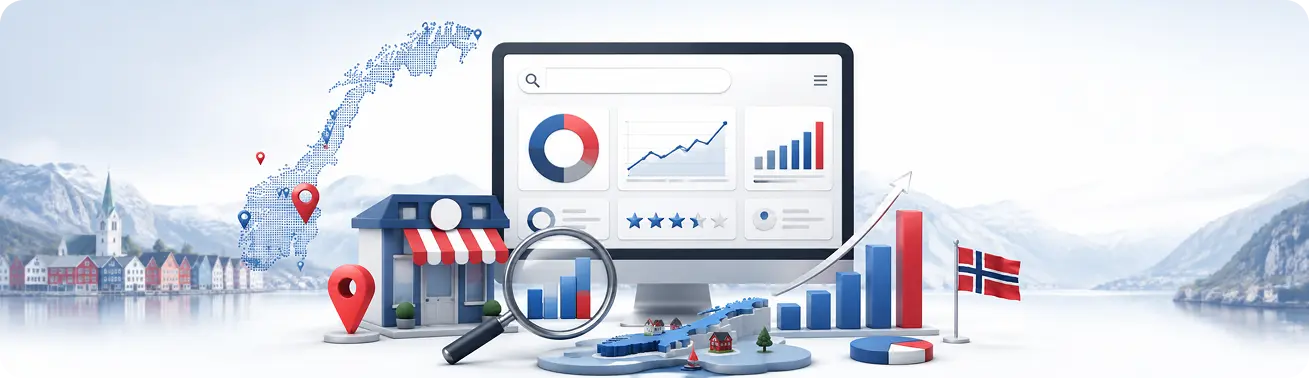
SEO is critical for Norwegian businesses that want to build market share in local markets and scale internationally in a consistent, organic way. SEO helps businesses gain trust and product awareness, and helps generate relevant traffic that increases sales. When done consistently, it can help you build a strong brand that drives traffic without any paid ads. In other words, SEO can help you establish your brand online so that, over time, it does not need any paid promotions to survive.
Many Norwegian companies use SEO to build brand awareness.
Norwegian tourism companies like Fjord Tour optimise their websites for local audiences in Geiranger and Bergen for searches like “best fjord tours Bergen” and “fjord cruise Norway.” They offer detailed guides, build backlinks to relevant sites, and optimise high-resolution images to rank on Google’s first page. This helps them attract targeted traffic of tourists that book directly through their website, eliminating the need for paid promotions or relying on third-party services or apps.
Local plumbing, renovation, and electrician service providers use local keywords to rank on Google’s first page in Norway. They use keywords like “electrician Oslo emergency” or “ renovation companies near me Trondheim.” The location-based keywords help them find local customers. With positive reviews and relevant keywords, local companies can appear in Google Maps results, which increases bookings and phone calls without the need for paid promotion.
Search Engine Optimisation is made up of several components that play a crucial role in the overall ranking of a website. Different SEO types work together to drive targeted traffic, including:
On-page SEO focuses on activities that improve ranking through internal factors.
On-page SEO techniques ensure that the content, keywords, images, headings, internal links and meta information are fully optimised to improve user experience and search engine rankings. It helps Google understand page relevance.
For example, optimising a blog post with relevant keywords in the title, body and meta information and linking it to relevant blogs and sites helps Google understand the topic and improve the post’s ranking in the search results. Without optimisation, Google can not understand the topic and therefore will not rank a web page.